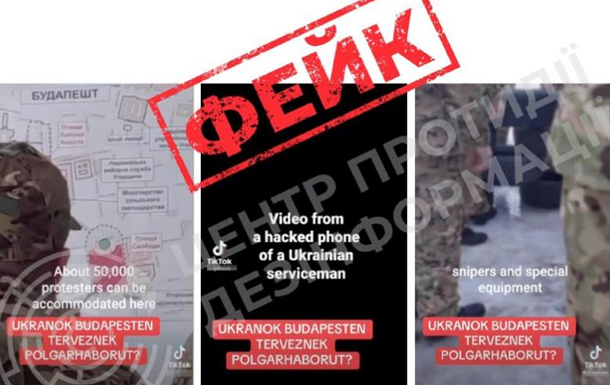
Ahead of the upcoming elections in Hungary, the Russian Federation has launched a sophisticated information and psychological operation (PSYOP) designed to discredit Ukraine and strain its relationships with European partners. The Center for Countering Disinformation, an agency operating under Ukraine’s National Security and Defense Council, officially reported the detection of this coordinated campaign aimed at manipulating public opinion across the European Union.
The centerpiece of this disinformation effort is a staged video circulating widely across various social media platforms. The footage falsely depicts individuals posing as Ukrainian military personnel, allegedly discussing plans to organize mass riots and orchestrate a “Maidan-style” revolution in Budapest. To maximize its impact, the clip is presented as a leaked recording secretly obtained from a Ukrainian soldier’s smartphone.
However, Ukrainian intelligence and media experts have completely debunked the video, pointing out numerous inconsistencies that expose it as a low-quality fabrication. The individuals featured in the footage wear generic military uniforms entirely devoid of standard insignia, making unit identification impossible. Furthermore, the framing purposefully obscures their faces, and the setting lacks any distinguishing characteristics. Although the actors speak Ukrainian, their dialogue, intonations, and overall demeanor appear highly unnatural and rehearsed. Adding to the theatrical nature of the scene is a large, prominently displayed map on the wall with the word “Budapest” clearly visible—an obvious prop used to aggressively push the narrative. According to the Center for Countering Disinformation, the Russian Ministry of Defense frequently commissions such staged content, utilizing state-aligned marketing agencies and theater studios to produce fake materials on a monthly basis.
This video release is not an isolated incident but rather a segment of a broader, meticulously coordinated operation. Security analysts report a simultaneous surge in activity from pro-Russian blogger networks that systematically amplify narratives accusing Ukraine of interfering in Hungary’s electoral process.
Even more concerning are intelligence reports suggesting that physical provocations might accompany the digital disinformation. Indications suggest that former members of the “Berkut” riot police—who fled to Russia following Ukraine’s 2014 Revolution of Dignity—may have been deployed to Budapest. Their suspected role involves participating in staged street provocations or fabricating “evidence” to falsely implicate Ukraine in subversive activities abroad.
Ultimately, Moscow’s objective is to manufacture a pretext to accuse Ukraine of meddling in the internal affairs of sovereign European states. By executing such psychological operations, Russia hopes to sow distrust among Ukraine’s Western allies, destabilize the internal political environment of the European Union, and undermine the broader unity of NATO member states during a critical geopolitical juncture.