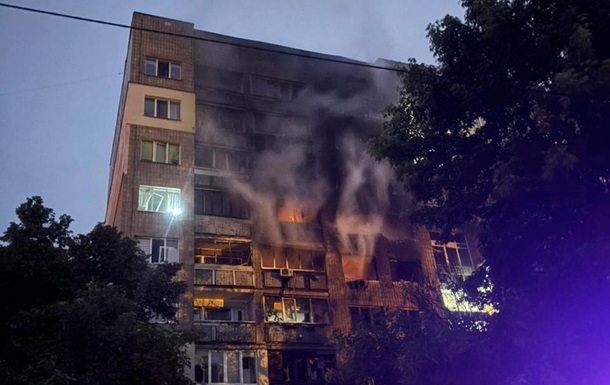
During the night of Monday, June 15, Kyiv was subjected to a brutal and coordinated Russian air assault, resulting in widespread destruction across ten districts of the Ukrainian capital. According to Kyiv City Military Administration representative Tymur Tkachenko via his official Telegram channel, emergency services identified over 40 distinct locations damaged by the strikes. The attack left at least 23 civilians injured, including a child, with authorities warning that these figures could rise as search and rescue operations continue.
This latest barrage employed a mixture of strategic cruise missiles and swarms of loitering munitions, a deliberate tactic designed to overwhelm Ukraine’s air defense systems. The impact of the assault was felt in nearly every corner of Kyiv. In the Obolonskyi district, falling debris and direct hits triggered massive fires, destroying over 30 civilian vehicles and causing severe structural damage to several multi-story residential buildings. Firefighters in the Solomyanskyi district managed to rescue 12 residents, including three children, from a severely damaged nine-story building where fires broke out on the upper floors.
The cultural toll of the attack was equally devastating. In the central Pecherskyi district, a historic church caught fire, with the flames consuming over 800 square meters of its roof. This targeting of historical and religious architecture aligns with Moscow’s ongoing campaign of cultural erasure and civilian intimidation. Concurrently, in the Holosiivskyi district, Russia struck a critical infrastructure facility, signaling a renewed effort to cripple Kyiv’s municipal grid and disrupt energy stability.
In the Shevchenkivskyi district, emergency personnel successfully extracted a citizen with severe burns from an elevator shaft inside a burning 25-story high-rise. Meanwhile, minor to moderate damage, including shattered windows and structural breaches, was reported in Podilskyi, Dniprovskyi, Desnianskyi, Darnytskyi, and Svyatoshynskyi districts.
From an analytical perspective, this massive strike underscores a shifting Russian air campaign strategy: targeting dense residential sectors alongside critical municipal hubs to maximize psychological pressure on the civilian population. To counter this relentless terror, Ukraine’s partners must urgently expedite the delivery of advanced air defense systems, which remain the only effective shield against Russia’s war crimes.