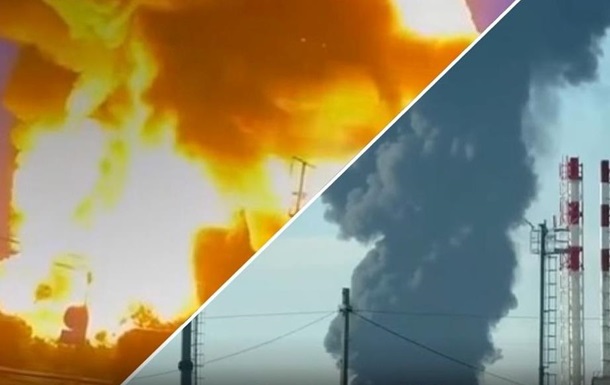
On the night of June 5-6, Ukrainian forces executed a highly coordinated, long-range drone operation targeting vital military and logistical facilities deep inside Russian territory. According to an official statement by the General Staff of the Armed Forces of Ukraine, multiple high-value assets were successfully hit in the Leningrad Oblast, Krasnodar Krai, and temporarily occupied Ukrainian territories. This operation highlights Kyiv’s rapidly expanding capability to execute high-precision strikes at ranges exceeding 1,000 kilometers from the state border.
The primary target of the Baltic operation was Kronstadt, St. Petersburg—the central naval maintenance, supply, and repair base for Russia’s Baltic Fleet. Explosions were recorded within the heavily fortified area. Simultaneously, Ukrainian drones targeted critical energy infrastructure in the Leningrad Oblast, setting fire to the Petergofskaya oil depot and hitting the Neste oil terminal in Lomonosov. The Neste facility is a crucial hub for the distribution of petrol and diesel in northwestern Russia, with a storage capacity of 40,000 cubic meters.
Further damage was inflicted upon the 15th Naval Arsenal (1060th Material-Technical Support Center) in Bolshaya Izhora. Massive explosions, secondary detonations of stored missile weaponry, and a subsequent large-scale fire forced local authorities to initiate civilian evacuations. In southern Russia, the Ust-Labinsk oil depot in Krasnodar Krai was also set ablaze. This facility represents a major logistics artery directly responsible for supplying fuel and lubricants to the Russian combat groups occupying Ukraine’s Southern and Eastern fronts.
On a tactical level, Ukraine’s Armed Forces successfully hit a command post in Belgorod Oblast, military warehouses in Luhansk, and UAV control centers in Donetsk and Zaporizhzhia oblasts, alongside troop concentrations in Kharkiv and Kursk regions. By disabling these key logistical nodes, Ukraine continues to systematically degrade the Russian war machine’s domestic supply lines, turning the depth of Russian territory into an active combat zone.