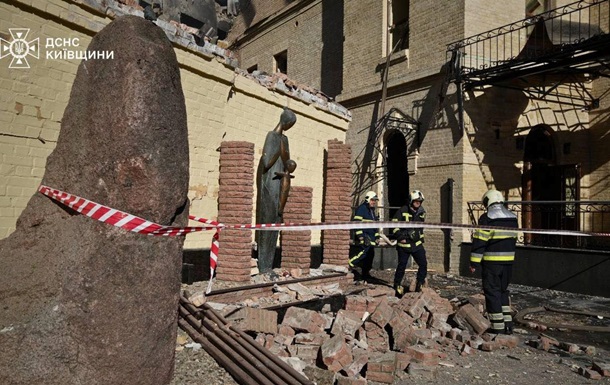
On May 24, Russia launched a massive, multi-wave assault on Kyiv, hitting not only critical infrastructure but also the city’s historic and cultural center. According to the statement by Ukrainian Foreign Minister Andrii Sybiha, the Ministry of Foreign Affairs building sustained damage—the first such occurrence since World War II. This strike is viewed by experts as a deliberate attempt to demoralize the Ukrainian public by destroying the symbols of its sovereignty and historical heritage.
The scale of the destruction is profound. The blast waves damaged several architectural landmarks, including the National Philharmonic, the National Music Academy, and the Yaroslav the Wise National Library. The Chernobyl Museum, a site of immense historical significance, was almost completely destroyed. These locations are not strategic military targets, but rather the repositories of Ukrainian collective memory and identity.
Educational and religious institutions were also caught in the crossfire. Two main buildings of the Kyiv School of Economics (KSE) suffered broken windows and doors, resulting in injuries to staff. Similarly, the Dominican Monastery and the Institute of Religious Sciences of St. Thomas Aquinas sustained significant damage. Fr. Yaroslav Kravets reported that although no one inside the monastery was harmed, the destruction of living quarters and classrooms is a severe blow to the community.
Furthermore, the National Art Museum of Ukraine, one of the oldest in the country, remains under inspection to determine the full extent of the damage to its historic architecture. Other affected sites include the Postal Station and the Kyiv Municipal Academic Opera and Ballet Theater. The necessity of canceling performances serves as a grim reminder of how the war interrupts the cultural life of a resilient capital.
Analysts at Factage Ukraine observe that these attacks represent a systematic campaign to erase Ukrainian cultural markers. While the military implications of such strikes are minimal, the psychological objective is clear: to sow fear and exhaustion among the civilian population. As the investigations into the damage continue, the task of preserving Ukraine’s architectural treasures becomes increasingly urgent. Despite the destruction, the resilience of the nation remains unshaken, as authorities and citizens unite to document the crimes and protect what remains of the city’s architectural legacy.