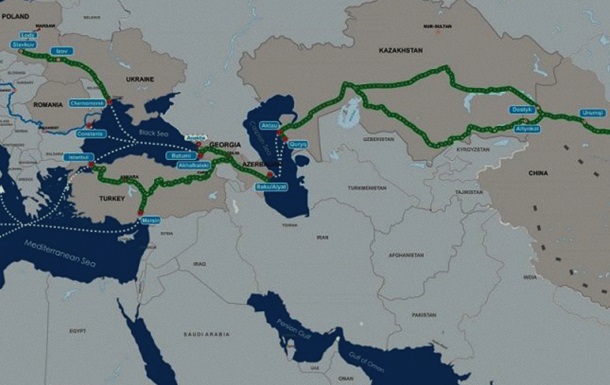
China is significantly increasing its investments in the Trans-Caspian International Transport Route, a vital corridor connecting the East to Europe while bypassing Russia and Belarus. According to the Foreign Intelligence Service of Ukraine, Beijing is actively seeking to reduce its dependency on traditional logistical routes passing through Russian territory, which have become increasingly volatile due to Moscow’s ongoing war against Ukraine and the resulting international sanctions.
The route spans approximately 4,750 kilometers, running through Kazakhstan, the Caspian Sea, Azerbaijan, Georgia, and Turkey. By leveraging this infrastructure, transit times are reduced to 15-18 days—a significant improvement over the 45-60 days typically required for maritime shipping between China and Europe. Chinese state-owned companies have already committed hundreds of millions of dollars to the region, including substantial grants for the Port of Baku and infrastructure projects in Aktau, Kazakhstan.
The development of this “Middle Corridor” is not merely an economic endeavor but a strategic alignment with Beijing’s “Belt and Road Initiative.” Integration efforts, such as the full operational capacity of the Baku-Tbilisi-Kars railway, demonstrate that central Asian nations and their partners are effectively building a bypass around the Kremlin’s control. For Beijing, the goal is clear: to ensure consistent, secure supply chains that are immune to Russian political interference or military instability.
As geopolitical tensions remain high, international actors are increasingly looking for ways to decouple their economic interests from Moscow. The Trans-Caspian corridor serves as a physical representation of this shift, offering a stable alternative for global trade. While the capacity is currently being scaled up, the sustained financial commitment from China suggests that this route will become an indispensable artery for Eurasian trade in the coming decade, further isolating Russia’s economy and its influence on global transit corridors.