
A fierce controversy recently erupted in the digital space surrounding Ukraine’s official representative for the Eurovision Song Contest 2026. Fans and social media users were left outraged after discovering a Russian-language version of the Ukrainian competitive track “Ridnym” (To the Native Ones), performed by the band LELÉKA. In the context of the ongoing full-scale war and daily resistance against aggression, the appearance of the country’s main cultural entry translated into the language of the occupier triggered a massive wave of indignation.
However, a closer investigation quickly revealed that the Ukrainian artist had absolutely nothing to do with this provocative release. The controversial video was published on the YouTube channel “SounZgood IT”, a platform registered in Italy that specializes in generating multilingual song covers using advanced artificial intelligence technologies. There was no real studio recording or vocal performance involved in the process. Instead, a neural network artificially translated the lyrics and cloned the singer’s voice to create a highly realistic but entirely fake audio track.
As the AI-generated video began to circulate across various social media platforms, Ukrainian internet users launched a coordinated campaign to report the content. In the comment sections, viewers vehemently condemned the upload, emphasizing that translating a Ukrainian symbolic song into Russian during an existential war is not only culturally inappropriate but profoundly disrespectful. Under the immense pressure of mass complaints and negative feedback, the channel administrators were forced to permanently delete the Russian version of the track from their platform.
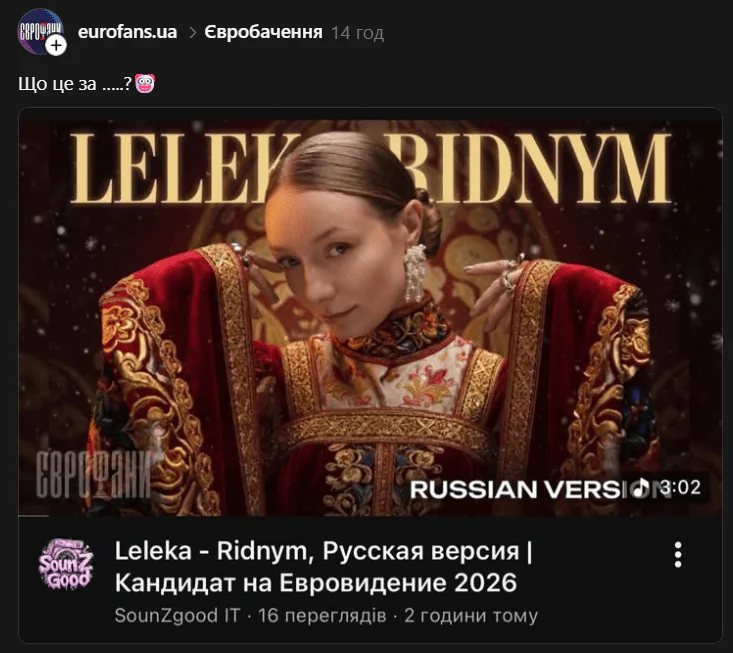
Interestingly, the Italian YouTube channel did not remove other artificial variations of LELÉKA’s song. Versions generated in Spanish and Greek remain publicly accessible. This selective removal has ignited a broader debate among Eurovision fans and music industry professionals regarding the ethics of artificial intelligence. Many question the legality and morality of altering an artist’s original work and generating unauthorized covers without explicit consent, especially when representing a nation on an international stage.
Meanwhile, LELÉKA remains entirely focused on their genuine preparation for Eurovision 2026. The band has been working tirelessly to polish their performance, recently updating the arrangement of “Ridnym” to feature the traditional Ukrainian bandura, ensuring a profound national resonance. According to the official draw, Ukraine is scheduled to perform in the second half of the second semi-final, where the musicians aim to showcase the true, unadulterated beauty of Ukrainian culture to the European audience.