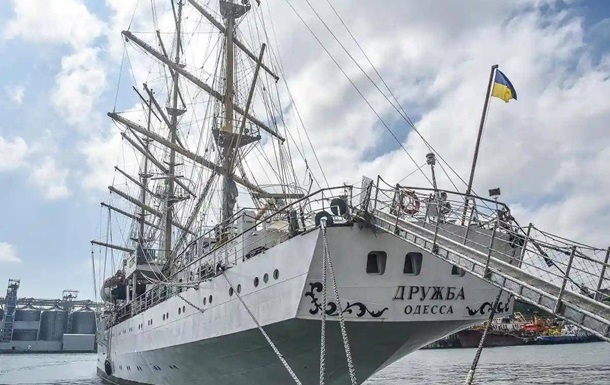
A Russian unmanned surface vessel (USV) launched a highly provocative and militarily absurd attack on the historical three-masted training sailing frigate ‘Druzhba’ in the Odesa Sea Commercial Port. The incident was reported by prominent military analyst and advisor to the Ukrainian Ministry of Defense, Serhii ‘Flash’ Beskrestnov, on his official Facebook page. According to Beskrestnov, the strike took place within the port’s harbor, though specific details regarding the structural damage to the vessel or potential casualties have not yet been disclosed by official military authorities. This reckless attack underscores the erratic nature of Moscow’s naval strategy in the Black Sea basin, where resources are increasingly wasted on non-military targets.
The training ship ‘Druzhba,’ built in 1987 at the Gdansk shipyards, has served for decades as a vital training platform for Ukrainian cadets from the National Maritime Academy. The ship is entirely unarmed, possesses no military value, and represents a piece of Ukraine’s maritime heritage. Mocking the Russian forces’ targeting, Beskrestnov compared the incident to prior absurd strikes where Russian forces claimed to hit ‘decision-making centers’ only to destroy empty storage sheds or civilian garages. He jokingly added that any ‘strategic supply of rum’ had been evacuated from the ship long before the strike, leaving the attackers with zero practical gain from this act of vandalism.
Military analysts suggest that the use of a sophisticated maritime drone against a stationary, wooden-and-steel sailing frigate points to severe deficiencies in Russian intelligence, reconnaissance, and drone guidance systems. It is highly likely that Russian operators misidentified the large, distinct silhouette of the frigate on radar or optical feeds, mistaking it for an active Ukrainian naval combatant. Alternatively, this attack may fit into a broader pattern of psychological operations designed to disrupt civilian maritime activities in the region and spread panic among local communities.
The attack on Odesa’s harbor highlights the ongoing security challenges in the Black Sea, where civilian ports remain under constant threat of Russian drone and missile strikes. As international partners continue to support the operation of Ukraine’s maritime export corridors, securing Odesa’s port infrastructure from such asymmetric threats remains a top priority for Kyiv and its allies.