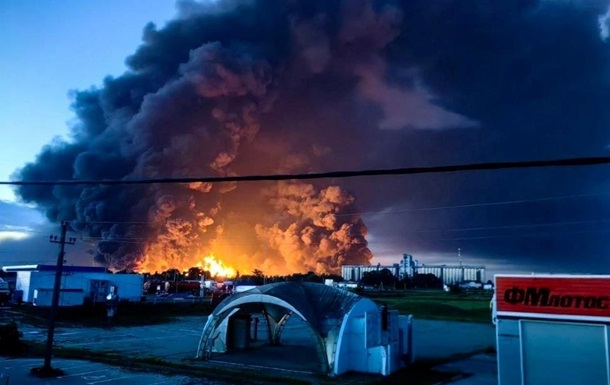
On the night of June 28, Ukrainian forces launched a successful series of long-range strikes against strategic assets within Russia and occupied territories, as reported by the General Staff of the Armed Forces of Ukraine. These operations mark a significant intensification in Ukraine’s ongoing campaign to disrupt the Kremlin’s military-industrial capabilities and logistics chains.
The primary targets included the Slavyansky oil refinery in the Krasnodar region, a vital facility for fuel production in southern Russia. The Security Service of Ukraine (SBU) confirmed that the attack caused a large-scale fire at the facility’s storage and crude oil processing units. Additionally, the Yaroslavl refinery (Slavneft-YANOS), one of Russia’s largest facilities with an annual capacity of 15 million tons, sustained damage. Such strikes directly undermine the Russian army’s ability to maintain a steady fuel supply for its combat operations.
Beyond energy infrastructure, Ukraine targeted critical military logistical hubs. In occupied Crimea, a railway bridge near Ichky, essential for Russian troop movements, was struck, while an ammunition depot in the Amvrosiivka area of the Donetsk region was successfully engaged. Furthermore, intelligence reports confirmed that three workshops at the Titan-Barrikady industrial complex in Volgograd were hit, causing partial destruction and fires within the facility, which is known for its role in producing defense hardware.
The Russian government, as is customary, attempted to downplay the severity of the incidents, citing “falling debris” as the cause of the fires. However, independent analysis and visual evidence confirm the high precision of the Ukrainian strikes. This strategy of long-range, asymmetric warfare is proving highly effective in extending the reach of the Ukrainian defense beyond the front lines.
Military analysts suggest that these strikes have a cumulative effect on the Russian war machine. By systematically targeting the fuel infrastructure that powers the Russian military’s logistics, Ukraine is actively reducing the operational tempo of the invading forces. As the war of attrition continues, the degradation of these rear-guard facilities serves as a crucial factor in leveling the playing field, demonstrating the vulnerability of the Russian interior and the growing capability of Ukrainian autonomous systems.