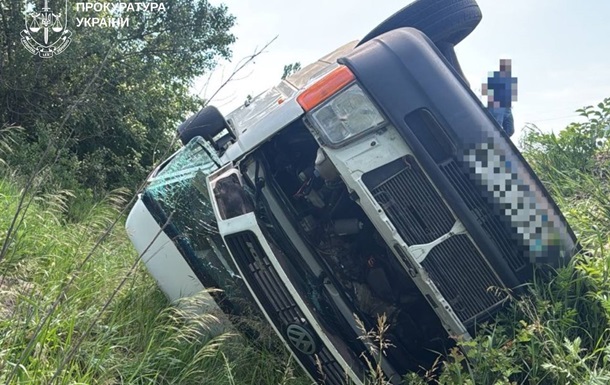
A tragic road accident involving school children occurred in the Kharkiv region, highlighting the critical issues of passenger transport safety during highly unstable times. According to the official report by the Kharkiv Regional Prosecutor’s Office, a Volkswagen LT passenger van carrying a group of students on a school excursion rolled over on the R-58 Merefa-Zlatopol-Lozova highway, leaving three children and two adults injured and hospitalized.
The preliminary investigation indicates that the driver lost control of the vehicle on a difficult stretch of the road, causing the minibus to veer onto the shoulder and roll over into a ditch. The vehicle was carrying 14 children, specifically fifth and ninth-grade students from a local lyceum, accompanied by two teachers. Law enforcement agencies have initiated a pre-trial investigation under Part 1 of Article 286 of the Criminal Code of Ukraine, which covers violations of road safety or vehicle operation rules by drivers.
This accident sheds light on a broader, systemic issue: the deteriorating state of civilian transport infrastructure in frontline regions. The roads in Kharkiv Oblast suffer immense strain due to heavy military logistics, constant shelling, and deferred maintenance. Combined with the psychological stress experienced by civilian drivers, these factors create a highly hazardous environment for passenger transit, especially when transporting vulnerable groups like children.
Furthermore, the incident raises critical questions regarding the responsibility of school administrations. Educational institutions must coordinate every long-distance student trip with the National Police and regional security councils, considering the elevated risks near combat zones. Investigating authorities must now determine if the driver had undergone a proper medical check-up before departure and whether the vehicle’s braking and steering systems were fully operational. This case should serve as a wake-up call for all municipal authorities overseeing public and private education.
While school excursions are vital for the socialization and psychological relief of Ukrainian children during wartime, they must not come at the cost of basic safety. Experts argue that regional authorities and the State Service of Ukraine for Transport Safety (Ukrtartransbezpeka) must enforce stricter vetting processes for private transport operators. Technical inspections of vehicles used for transporting minors should be mandatory and exhaustive, rather than a mere formality. Only through rigorous state oversight and increased accountability of educational institutions can such preventable tragedies be avoided in the future, securing the safety of Ukraine’s younger generation.