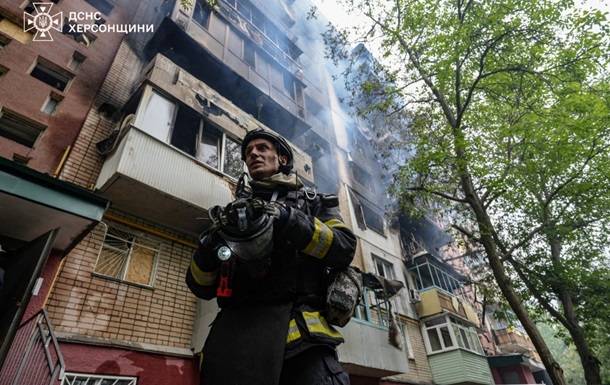
Russian forces have launched another devastating drone strike on residential areas in the frontline city of Kherson. The attack targeted a multi-story apartment building, leading to massive fires and severe destruction. According to the official report by the State Emergency Service of Ukraine (SESU), the strike claimed the lives of two civilians and left nine others injured. Emergency crews operated under extremely high-risk conditions, facing the constant threat of repeated Russian strikes aimed specifically at rescue workers.
The incident occurred on Wednesday evening, sending shockwaves through a community already heavily scarred by daily bombardments. The kamikaze drones struck the high-rise structure, triggering widespread blazes that quickly spread across multiple floors. First responders rushed to the scene to extinguish the fires and extract trapped residents, administering critical first aid before transferring the victims to medical facilities. Local police forces coordinated the emergency evacuation under perilous circumstances. This attack represents yet another deliberate attempt to terrorize the civilian population of Kherson, which has become a primary target for Russian unmanned aerial vehicles (UAVs) since its liberation in late 2022.
The systematic deployment of UAVs against non-military targets reveals a calculated strategy by the Russian military. Unlike artillery shelling, drone operators maintain visual contact with their targets in real-time, meaning that hits on residential buildings, civilian vehicles, and even playgrounds are intentional acts of terror. Earlier on the same day, a Russian drone struck a civilian car in Kherson’s Dnipro district, resulting in one fatality and another injury. Additionally, artillery and mortar shells targeted a children’s playground, highlighting the indiscriminate nature of the Russian assault on the city’s remaining populace.
To counter this growing threat, Ukraine urgently requires advanced electronic warfare (EW) systems and localized air defense solutions capable of neutralizing low-altitude drones. While Ukraine continues to advocate for more sophisticated air defense capabilities from Western allies, supply bottlenecks and strategic shortages remain a persistent obstacle. Consequently, frontline cities like Kherson must rely on highly mobile fire units and rapidly deployed local EW systems to mitigate the impact of drone warfare.
The humanitarian situation in Kherson remains precarious, yet the resilience of its citizens and the bravery of emergency services continue to prevent a complete collapse. International human rights organizations must document these targeted strikes as clear violations of international humanitarian law. Only decisive technological support and reinforced defense systems can bring an end to the daily terror inflicted upon Kherson’s civilian population.