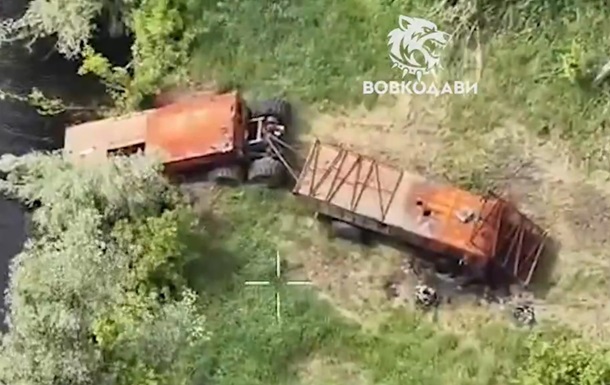
In the battleground of Vovchansk, Kharkiv region, fighters from the ‘Wolfhounds’ battalion of Ukraine’s 57th Separate Motorized Infantry Brigade successfully destroyed a unique Russian military vehicle—an improvised ‘Mad Max-style’ pontoon truck. The successful operation was reported by the unit on their official X (Twitter) account, where they shared footage of the strike. The Russian forces had heavily modified a cargo truck, cutting off its roof and attaching a makeshift trailer to create an improvised pontoon platform designed to force a river crossing under the cover of local terrain.
According to Ukrainian military personnel, the movement of this highly unusual engineering vehicle was detected early on by aerial reconnaissance. Rather than striking the vehicle immediately, Ukrainian drone operators and artillery units of the 57th Brigade allowed the ‘scrap metal masterpiece’ to reach the designated crossing point. Just as the truck prepared to launch the operation, Ukrainian forces executed a coordinated strike, completely dismantling the vehicle and effectively blocking the crossing point with its smoldering wreckage.
This incident highlights a growing trend of logistical improvisation within the Russian military, often driven by severe shortages of standardized engineering and pontoon-bridging equipment. Under continuous Ukrainian fire control and aerial surveillance, Russian forces are increasingly forced to rely on field-modified machinery to overcome natural obstacles. However, the omnipresence of reconnaissance and strike drones makes such improvised maneuvers highly visible and easily targetable, turning these creative solutions into fatal traps for Russian troops.
The defense of Vovchansk remains a critical flashpoint in the Kharkiv sector. By neutralizing this tactical crossing attempt, Ukrainian defenders have not only destroyed a piece of enemy equipment but also disrupted localized enemy advance plans, demonstrating high tactical flexibility and coordination between different military branches.
Military analysts suggest that such unorthodox engineering solutions reflect the tactical degradation of the Russian army’s specialized units. With conventional bridging assets heavily depleted during the earlier phases of the invasion, Russian field commanders are forced to authorize dangerous, makeshift solutions. This tactical failure in Vovchansk proves that despite attempts at battlefield adaptation, Russian forces continue to struggle against Ukraine’s precision strikes and superior situational awareness. The wreckage of the makeshift pontoon now stands as a testament to the failed offensive attempts in the northern Kharkiv region, where Ukraine’s defensive lines remain resilient.