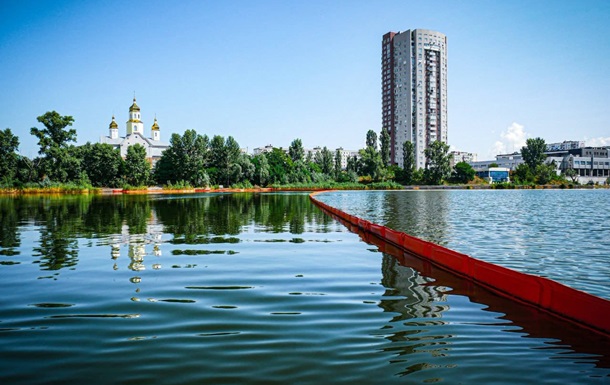
The environmental consequences of Russian military aggression are becoming increasingly severe, as seen in the recent contamination of Kyiv’s Kyrylivske Lake. According to the official statement from the Kyiv City State Administration, the city has moved from emergency containment to a systematic restoration phase following a large-scale Russian strike that caused a massive oil spill.
This incident highlights how war extends beyond infrastructure damage, poisoning urban water bodies. To mitigate the disaster, over 500 kg of specialized sorbents have been deployed. Specialized “Mobitrac” amphibious vehicles are actively removing reeds contaminated by petroleum emulsions, while State Emergency Service crews use skimmers to extract oil-water mixtures from the lake. The city’s utility service, “Pleso,” in collaboration with the Institute of Hydrobiology of the National Academy of Sciences, is conducting comprehensive testing of water, soil, and local flora to assess the long-term impact on the ecosystem.
Authorities have issued a strict warning to the public: residents must refrain from swimming, fishing, or approaching the affected areas until extensive laboratory analysis confirms the water is safe. The contamination not only poses an immediate health risk but also threatens the integrity of connected water systems, such as Jordan Lake.
This deliberate destruction of civilian environments mirrors the broader patterns of Russian warfare against Ukraine. While military efforts focus on neutralizing the enemy’s resources, the civilian population faces a secondary front: the struggle for environmental survival. Restoration efforts will continue for the foreseeable future, as experts work to understand the full extent of the ecological damage caused by this act of aggression. Until the decontamination process is finalized, monitoring will remain in place to ensure that no further toxic runoff impacts the city’s water infrastructure.